
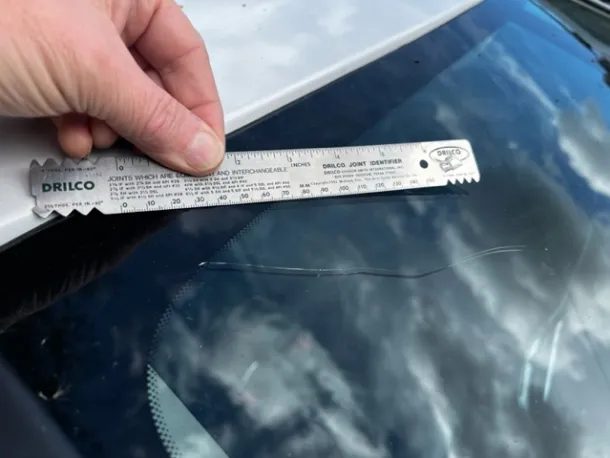
Your windscreen isn’t just about visibility — it provides up to 30% of your vehicle’s structural strength, increasing further during frontal collisions or rollovers.
This makes MOT-compliant windscreen condition critical for both legal compliance and occupant safety. An MOT, short for the Ministry of Transport test, constitutes a compulsory annual evaluation of car safety and emissions for vehicles in the United Kingdom.
The primary objective of this test is to ensure that your vehicle complies with the minimum standards established by the Driver and Vehicle Standards Agency (DVSA).
MOT testers must adhere to stringent guidelines to guarantee a fair and precise assessment. Certified mechanics conduct this test at authorised MOT stations.
Before the examination, it is essential that the car’s registration and insurance are up to date and the vehicle is free from visible damage or defects.
Upon entering the testing bay, the mechanic performs a series of checks, which include inspecting the car’s tyres, windscreen, brakes, steering, and suspension.
The priority of an MOT is to monitor the safety, roadworthiness, and exhaust emissions of vehicles on UK roads — the initial MOT test is mandatory three years after registration (for new cars) and subsequently annually.
MOT — when should you go?
In the United Kingdom, it is a legal requirement that all cars over three years old must possess a valid MOT certificate.
There are several methods to determine when your car’s MOT is due. You can find this information on your car’s registration document or utilise the online MOT history service. This service provides you with the date of your car’s next MOT and its current status.
If your car is approaching its MOT due date, schedule an appointment with a registered testing centre as soon as possible. The test typically takes about an hour and can often be completed while you wait.
Maintaining a valid MOT certificate is crucial to keeping your car legally on the road, so staying informed and up-to-date is essential.
Get MOT reminders — sign up here.
MOT and visibility: an insight into safety standards
At UK Car Glass, we want to keep you informed and assist you when your vehicle’s visibility is no longer satisfactory. We understand that clear visibility is vital for safe driving, and that’s why we’re dedicated to ensuring your vehicle meets the highest safety standards required by MOT tests.
Let us explore the significance of visibility in MOT assessments and provide insights into the safety standards your vehicle must adhere to.
This section falls under the interior checks: view to the front, wipers, and washers.
MOT — rules about a damaged or cracked windscreen
Your vehicle’s windscreen is critical for safe driving, and it’s important to grasp the factors that can impact its condition.
Obstructions in your view
- If anything blocks what you can see in front or to the sides of your windscreen, it’s a problem.
- If you can’t see an obligatory external mirror because of such obstructions, that’s also an issue.
Glass condition
- Damage larger than 10 mm in diameter in “Zone A” of your windscreen is concerning.
- In the rest of the swept area (Zone B), damage exceeding 40 mm in diameter needs attention.
- When your windscreen has excessive tinting or discolouration, it can create visibility problems.
- Edge damage: chips or cracks within 5–7 cm of the windscreen edge typically require replacement, as repairs in this area are less effective and may fail MOT.
Damage types
- Repairable: small chips, bullseye breaks, and star breaks (provided they meet size and location criteria).
- Requires replacement: spider-web cracks, long cracks, deep multi-layer cracks, or damage penetrating both laminate layers.
Zone A explained
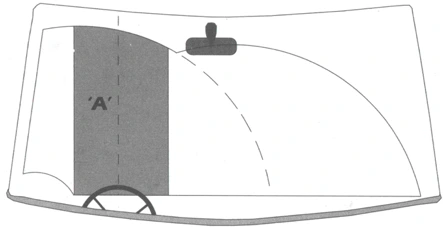
- Zone A is a specific area in the cleared part of your windscreen.
- It’s 290 mm wide and centred around your steering wheel.
Repairs to your windscreen
- When the MOT technician checks a repaired windscreen, they focus on whether the repair affects your ability to see clearly. Repairs meeting the British Standard BS AU 242b:2022 are safe, long-lasting, and usually barely noticeable once complete — making them MOT-compliant when done correctly.
- It doesn’t necessarily count as damage if the repair is nearly invisible and doesn’t stick out.
Defects simplified
- Your windscreen can be deemed defective if it’s damaged or severely discoloured.
- If excessive tinting makes it hard to see through the cleared area or the obligatory mirrors, it’s a defect.
- If your windscreen is in bad shape due to many scratches and impairs your view, that’s also considered a defect.
Windscreen failure
If your windscreen has a chip or crack, it’s essential to know the size limits for this type of damage. In the driver’s line of vision (290 mm wide area centred around the steering wheel), the maximum allowable damage is 10 mm. In other areas swept by the wiper blades, the limit is 40 mm.
Additionally, chips or cracks within 5–7 cm of the windscreen edge usually require replacement as they compromise structural integrity.
When your car’s windscreen is likely to fail its MOT due to damage, you have two viable options:
The first option involves repairing the windscreen. This can typically be arranged at various locations, including dedicated windscreen repair shops and many workshops equipped with windscreen repair equipment.
Not all types of damage can be repaired.
If damage in Zone A (driver’s line of vision) exceeds 10 mm, replacement is required.
Outside Zone A, chips up to 25 mm (approximately a £1 coin) and cracks up to 75 mm (7.5 cm) can often be repaired, provided they’re at least 5–7 cm from the windscreen edge.
The second option is to opt for a windscreen replacement. You can have this done at a specialised mobile windscreen replacement company or at a workshop.
By addressing your windscreen damage beforehand and choosing the appropriate course of action, you can ensure that your vehicle meets the required safety standards for a successful MOT test.
ADAS calibration & MOT compliance
Many modern vehicles have windscreen-mounted cameras and sensors for Advanced Driver Assistance Systems (ADAS), including lane-keep assist and emergency braking.
If your windscreen is replaced, these systems must be recalibrated to factory specifications.
From 2024, ADAS-equipped vehicles require proper calibration to pass MOT. Even minor misalignment can cause safety systems to malfunction or trigger an MOT failure.
When replacing your windscreen, always confirm that ADAS calibration is included to ensure your vehicle remains MOT-compliant and safe to drive.
We recommend
We strongly advise addressing any windscreen damage as soon as possible.
We offer next-day service when you book before 4pm, ensuring you’re MOT-ready without last-minute stress.
Waiting until just a few days before could potentially leave you in a situation where you might not be able to get the necessary assistance in time.
Your early action can help you avoid any last-minute inconveniences.
Key takeaways
- Zone A = 290 mm wide area centred on the steering wheel; damage >10 mm = MOT fail
- Zone B = rest of the wiper-swept area; damage >40 mm = MOT fail
- Edge damage within 5–7 cm of the windscreen edge usually means replacement (not repair)
- From 2024, ADAS calibration is mandatory for MOT compliance after windscreen replacement
- Repairs done to BS AU 242b:2022 are MOT-compliant — get small chips fixed before your test