
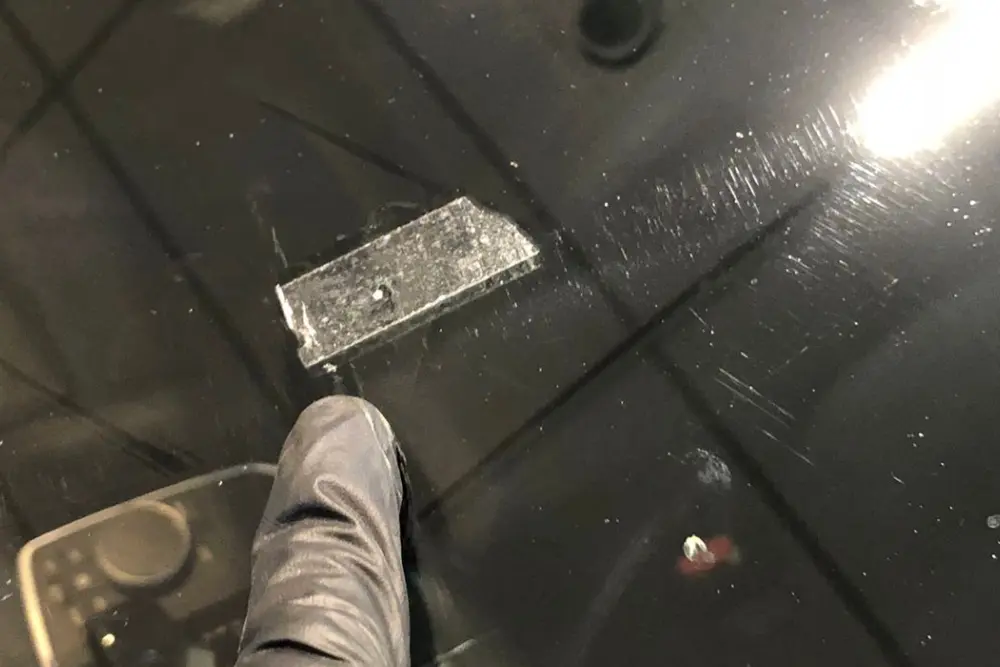
Your windscreen: three layers
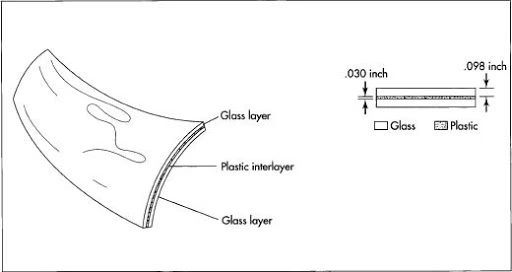
The windscreen consists of three layers: two sheets of regular glass with an inner layer of plastic known as Polyvinyl Butyral (PVB) consolidated between the two pieces under high pressure.
This lamination layer serves a crucial safety function by holding the broken outer panes of glass together in the event of an accident, protecting the car’s occupants by preventing dangerous glass shards from dispersing into the cabin.
Assess the windscreen damage
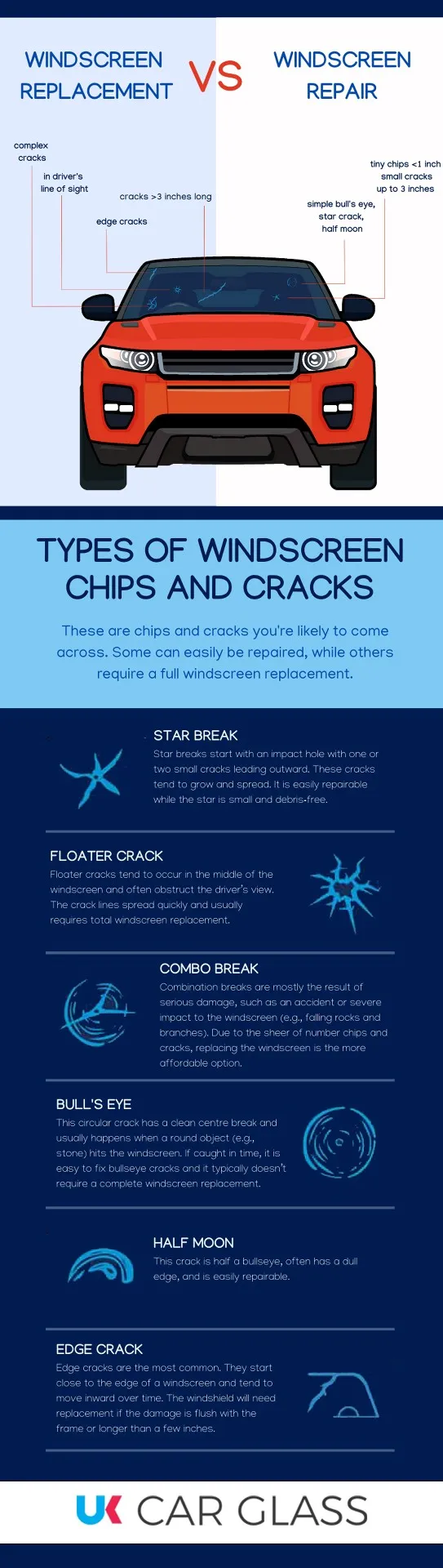
Fortunately, most minor chips and cracks are repairable without needing to replace the entire windscreen.
When assessing the damage, it’s important to consider four factors:
- Type
- Size
- Depth
- Location
Type
There are many different types of cracks, depending on what caused the damage and the speed at which it hit.
Some are fixable, others not.
Bullseye
This circular crack has a clean centre break and usually happens when a round object (e.g., stone) hits the windscreen.
If caught in time, it is easy to fix bullseye cracks, and it typically doesn’t require a complete windscreen replacement.
Half moon
This crack is half a bullseye, often has a dull edge, and is easily repairable.
Edge crack
Edge cracks are the most common. They start close to the edge of a windscreen and tend to move inward over time.
The windscreen will need replacement if the damage is flush with the frame or longer than a few inches.
Floater crack
Floater cracks tend to occur in the middle of the windscreen and often obstruct the driver’s view.
The crack lines spread quickly and usually require total windscreen replacement.
Star break
Star breaks start with an impact hole with one or two small cracks leading outward. These cracks tend to grow and spread.
It is easily repairable while the star is small and debris-free.
Combo break
Combination breaks are mostly the result of serious damage, such as an accident or severe impact to the windscreen (e.g., falling rocks and branches).
Due to the sheer number of chips and cracks, replacing the windscreen is the more affordable option.
Size
Most auto glass repair technicians will be able to repair chips up to 25 mm (approximately the size of a £1 coin), and cracks up to 75 mm (7.5 cm) long.
Depth
If the chip or crack has gone through all three layers of glass, it likely is unfixable. Even if it is just a small hole, it will be an area of weakness that undermines the strength of the entire windscreen.
Location
Chips and cracks in the driver’s line of sight require a complete windscreen replacement.
No matter how good the repair job is, there may still be some mistiness, discolouration, or unevenness which can distract the driver.
It will also result in MOT failure — something you certainly don’t need.
Damage near the windscreen’s edge (where it meets the metal frame) is also an essential consideration.
Even a minor crack in this position will weaken the integrity of the windscreen and compromise your safety.
This is because part of the crack or chip may be out of sight beneath the frame and impossible to repair safely.
Anything closer than 7 cm to the edge will require a windscreen replacement.
Can the windscreen repair or replacement wait?
A cracked or chipped windscreen can result in an instant MOT failure — in fact, nearly 1 in 10 vehicles fail their MOT due to visibility defects.
The outcome depends mainly on the position and extent of the damage.
There are many reasons why you should repair windscreen chips and cracks as soon as possible. Cracks lengthen quicker than you think.
One day you have a tiny chip, and next there’s a long crack along your windscreen. It could mean the difference between an affordable chip repair and an expensive glass replacement.
In addition, dust and moisture settle in the nooks and crannies of a crack over time and cause further damage.
Finally, and most importantly, a chipped or cracked windscreen is a safety concern. Even tiny imperfections compromise the integrity of the glass.
The two critical MOT zones
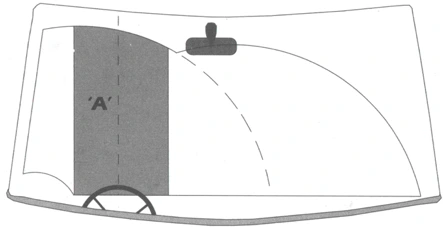
For MOT purposes, it’s important to distinguish between the different zones of the windscreen.
Zone A (driver’s direct view): this is a 290 mm-wide area centred on your steering wheel — essentially your direct line of sight while driving.
Any damage larger than 10 mm in this zone will result in an MOT failure.
While some minor chips under 10 mm may pass, it’s best to address any damage in this critical area immediately.
Zone B (rest of the windscreen): this covers the remainder of the windscreen outside the driver’s direct view.
Damage up to 40 mm may be acceptable, but anything larger will require a complete windscreen replacement to pass your MOT.
Remember: even if damage falls within these limits, it can still compromise your safety and should be repaired as soon as possible.
Driving with a cracked windscreen: the legal reality
Driving with a cracked or damaged windscreen isn’t just unsafe — it’s a breach of your legal duty to keep your vehicle roadworthy.
Under the Road Traffic Act 1988 and Regulation 30 of the Road Vehicles (Construction and Use) Regulations 1986, you’re required to maintain all vehicle glass in roadworthy condition.
Penalties for non-compliance include:
- Fines of up to £2,500
- 3 penalty points on your driving licence
- Potential driving disqualification in serious or repeated cases
Even if the damage “doesn’t affect your view,” police can issue an on-the-spot fine. And if your car fails its MOT on windscreen damage, it’s legally unfit for road use until the defect is repaired or replaced.
Don’t make these common windscreen mistakes
Over the years, we’ve seen drivers make the same preventable errors that turn minor damage into major expenses.
Here are the most common pitfalls to avoid:
Pouring boiling water on frozen glass
That kettle of hot water seems like a quick solution on a frosty morning, but the sudden temperature shock can create instant cracks.
Use lukewarm water or de-icer spray instead, and let your car’s heater do the rest.
Delaying repairs on small chips
“I’ll sort it next week” often becomes “Why is there a crack across my entire windscreen?”
Road vibrations, temperature changes, and moisture can turn a repairable chip into a full replacement within days.
If it’s smaller than a £1 coin and away from the edges, book a repair immediately.
Using DIY kits on damage in your line of sight
High-street repair kits can work well on minor chips in low-priority areas, but if the damage is directly in front of you (Zone A), professional repair or replacement is essential.
Even perfectly applied resin can leave slight distortion that will fail your MOT.
Assuming you’re fine if you “can still see clearly”
Your ability to see through the windscreen isn’t the legal test. MOT limits are strict:
10 mm in Zone A or 40 mm in Zone B means your car is unroadworthy, whether you think it affects your vision or not.
Not checking your insurance excess first
Many drivers automatically claim through insurance without checking the numbers.
With excess typically around £75–£100 and potential premium increases at renewal, paying privately for a straightforward replacement can actually cost less in the long run.
Windscreen repair vs replacement: what you need to know
Once you’ve assessed the damage, the next question is straightforward: repair or replace?
Here’s how they compare:
Cost & time: the key differences
- Repair: £78 fixed price, typically 15–20 minutes for a simple chip
- Replacement: £299–£1,200 depending on your vehicle, takes 60–90 minutes plus 30–90 minutes minimum drive-away time
- Act fast: delays turn repairable chips into expensive replacements
Quality standards matter
All repairs and replacements should be carried out to BS AU 242b:2022 standards by IMI-certified specialists in our network using OEE-certified windscreens.
Professional repairs meeting this standard are:
- Safe and long-lasting
- MOT-compliant when done correctly
- Typically barely noticeable once complete
Important limitation: if you’ve had more than eight chip repairs on the same windscreen, it’s time for a full replacement.
Why your windscreen is safety-critical
Your windscreen does far more than keep the wind out:
- Structural integrity: provides up to 30% of your car’s structural strength, especially during frontal collisions and rollovers
- Airbag deployment: acts as a backstop for passenger airbags — a weak or incorrectly fitted windscreen can detach during deployment, causing the airbag to inflate over the dashboard instead of protecting occupants
- Chassis rigidity: keeps your cabin rigid under impact
An incorrectly fitted windscreen, or one with too many poor-quality repair jobs, compromises all of these safety functions.
ADAS-equipped vehicles (2024 MOT requirement)
If your car has windscreen-mounted cameras or sensors:
- MOT requirement: proper ADAS calibration is now mandatory to pass your MOT (introduced 2024)
- Precision matters: even a millimetre of misalignment can cause safety systems to malfunction
- Always confirm: check that ADAS calibration is included when booking your replacement
Key takeaways
- Most chips smaller than a £1 coin (25 mm) and cracks under 7.5 cm are repairable for £78
- Damage in Zone A (driver’s direct view) over 10 mm is a replacement and an MOT fail
- Damage in Zone B (rest of swept area) over 40 mm is a replacement and an MOT fail
- Damage within 7 cm of the edge usually means replacement, regardless of size
- Driving with a cracked screen risks £2,500 fine + 3 licence points — and an MOT fail makes the car legally unfit for the road