
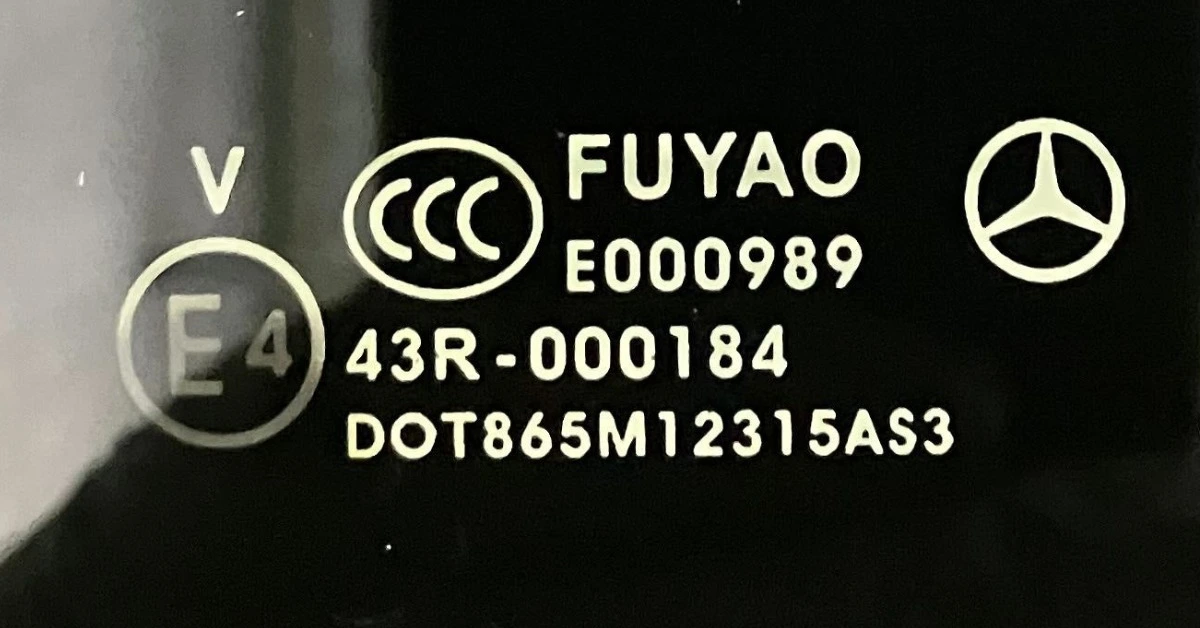
What does OE mean? (Original Equipment)
OE (Original Equipment) glass is the official branded part that was installed by your car manufacturer at the factory. It’s also the same branded replacement part you would purchase directly from a dealership.
OE glass is distinguished by one key feature: it generally carries two logos:
- Your vehicle manufacturer’s logo (such as Ford, BMW, or Audi)
- The glass manufacturer’s logo (such as Pilkington, Saint-Gobain, or AGC)
Here’s what’s interesting:
OE glass is physically identical to its equivalent versions, but it typically commands a 40–60% premium because it’s sold through official manufacturer channels.
You’re essentially paying for the branding and the dealership distribution network.
What does OEM mean? (Original Equipment Manufacturer)
This is where things get a bit confusing, so pay attention.
OEM doesn’t refer to a type of glass at all — it refers to the company that manufactures the factory-fitted glass.
Major OEMs include Pilkington, Saint-Gobain Sekurit, AGC, XYG and Fuyao.
Sometimes your car glass can consist of different glass manufacturers — one for the windscreen and rear window, and another for the side windows.
These manufacturers produce the original windscreens used in new vehicles coming off the production line. They also make replacement glass to the exact same technical specifications.
In other words, OEM is the manufacturer, not a label you’ll see on the glass itself.
These companies supply both:
- Branded OE parts for vehicle factories and dealerships
- Unbranded OEE parts for all car models, regardless of contract
A real example: a nearly-new Mitsubishi with no Mitsubishi brand stamp on the windscreen — only the glass manufacturer’s logo. The vehicle was new enough that it almost certainly still had its original factory-fitted glass.
The presence of the car brand logo is normally a quick check for whether glass has been replaced — if both logos are present, it’s likely the OE glass; if only the glass manufacturer logo is visible, it’s possibly been replaced with OEE glass (the aftermarket equivalent).
But here was factory-original glass with no vehicle brand logo.
The lesson? Even some car manufacturers choose not to brand their factory-fitted windscreens, particularly on volume models where branding adds cost without functional benefit.
This is why the terminology is so confusing — even “OE” glass doesn’t always follow the “two logos” rule.
What matters isn’t the number of logos stamped on your windscreen — it’s that the glass meets safety standards and is manufactured by a reputable OEM producer.
What does OEE mean? (Original Equipment Equivalent)
OEE (Original Equipment Equivalent) glass is where smart vehicle owners find exceptional value.
OEE glass is manufactured to the same specifications and safety standards as OE glass, but it’s produced for the aftermarket rather than being branded for dealerships, or sold from the manufacturer without the car brand logo.
The crucial difference? It carries only the producing glass manufacturer’s logo — not the vehicle brand.
But make no mistake: OEE glass manufactured by an OEM offers identical fitment, optical clarity, and ADAS compatibility as OE glass.
The performance is the same; you’re simply not paying the dealership markup.
This is why OEE glass is the preferred option for most independent installers and insurance companies.
It combines top-tier safety and precision without the premium price tag.
Why OEE glass sometimes has a bad reputation
It’s important to understand that “aftermarket glass” is a broad category — and not all aftermarket glass is created equal.
The aftermarket includes:
- High-quality OEE glass from established OEM manufacturers (Pilkington, Saint-Gobain, AGC)
- Lower-grade glass from manufacturers who don’t produce OE parts for vehicle factories
This is why OEE glass sometimes gets unfairly lumped in with inferior products.
The key distinction is this: if the glass is manufactured by a recognised OEM — a company that also produces OE parts for car manufacturers — you’re on the safe side.
The “Chinese glass” misconception
“Please, no cheap Chinese glass.”
This reaction is understandable — customers want quality — but it’s based on outdated assumptions about manufacturing capabilities.
Yes, we exercise caution: for vehicles with full ADAS systems requiring precise calibration, we prioritise glass from manufacturers with proven track records in these specific applications.
But quality isn’t determined by country of origin: major Chinese manufacturers like Fuyao or XYG produce OE glass for premium brands including Mercedes-Benz.
If a Chinese manufacturer is trusted by Mercedes to supply factory-original glass, their manufacturing capability clearly meets the highest standards.
The key isn’t where the glass is made — it’s whether the manufacturer:
- Holds OE contracts with major car manufacturers
- Meets ECE R43 and UK safety standards
- Has proven ADAS compatibility for your specific vehicle
Which glass should you choose for your vehicle?
The answer depends largely on your vehicle’s age and warranty status.
For newer vehicles (under 3 years old)
If your vehicle is still covered by a manufacturer warranty or is less than three years old, we recommend using OE or OEE glass (Original Equipment Equivalent).
This ensures:
- Complete optical accuracy
- Optimal ADAS performance
- Full compliance with any remaining manufacturer warranty conditions
- The closest match to your original factory installation
For older vehicles (over 3 years old)
For vehicles older than three years, high-quality OEE glass is typically more than sufficient.
It provides the same:
- Structural safety
- Perfect fitment
- Optical clarity
- ADAS compatibility
The only difference is the price — and it’s a significant one.
The real cost difference: what you’ll actually pay
Understanding the price difference helps you make an informed decision. Here’s what you can expect.
Recent real-life example: Mercedes A-Class 2019 windscreen
| Glass type | Price | What you’re paying for |
|---|---|---|
| OE glass (dealership) | £887.88 | Original part + dealership branding + premium distribution network |
| OEE glass (OEM-standard aftermarket) | £661.00 | Identical quality + OEM-level specification + direct pricing |
| Your savings | £226.88 | 25.55% less for the same safety and performance |
Another example: Audi RSQ8 2024
Since the windscreen is the same for models produced from 2019 onwards, it’s perfectly fine to choose the OEE/aftermarket version for a 2024 model.
Had it, on the other hand, been the start of a new generation — for example, 2023 onwards — I would have personally opted for OE glass instead, if the budget allowed.
| Glass type | Price | What you’re paying for |
|---|---|---|
| OE glass (dealership) | £1,588 | Original part |
| OEE glass (UK Car Glass) | £1,058 | Aftermarket |
| Your savings | £530 | 50.09% less for the same safety and performance |
What creates this price gap?
The average range is typically 40–60% on premium OE glass versus OEE.
It is not always about better quality — it’s about the supply chain:
- Dealership overheads: showroom costs, commissioned sales staff, and higher profit margins
- Brand licensing: vehicle manufacturers charge for the right to display their logo
- Distribution markup: multiple intermediaries between manufacturer and customer
- Market positioning: premium pricing strategy to maintain “official” status
With OEE glass, you bypass these markups and buy directly from the same manufacturers, getting identical quality at a fair price.
Why does the difference actually matter?
Modern windscreens are far more than just a sheet of glass — they’re integral components of your car’s safety systems. Today’s windscreens work in coordination with:
- ADAS cameras for lane departure warnings and automatic braking
- Rain sensors for automatic wipers
- Heads-up displays (HUDs) that project information onto the glass
- Structural integrity of the vehicle cabin
Even minor differences in glass thickness, curvature, or optical quality can affect sensor calibration, cause distorted HUD projections, or lead to MOT issues down the line.
That’s precisely why UK Car Glass typically uses OEM-standard glass.
We ensure:
- ✓ Perfect fitment and sealing
- ✓ Accurate ADAS calibration
- ✓ Full compliance with UK and manufacturer safety standards
Our commitment to quality glass
Our network typically sources directly from the world’s leading OEM manufacturers, including Pilkington, or wholesalers that stock Saint-Gobain Sekurit, AGC, and other certified producers.
Depending on availability in your region, your replacement glass will be OEE-quality, meeting or exceeding factory performance and safety requirements.
In the rare event that OEE glass from a certified OEM manufacturer is unavailable for your specific vehicle (e.g., due to extreme low stock), we will use only high-quality, safety-approved aftermarket glass. We guarantee that this glass is manufactured to be fully compliant with the mandatory ECE R43 safety and road-legal standards for UK vehicles.
Here’s our guarantee: we never install low-grade aftermarket glass. Every replacement is engineered for the same safety, clarity, and strength as your car’s original windscreen. No compromises, no exceptions.
Understanding supply chains and stock availability
Even the most trusted OEM manufacturers sometimes source glass from other approved producers to maintain stock availability.
For example, Pilkington — one of the world’s most respected glass manufacturers — may occasionally stock car glass not produced by them, particularly for less common or low-demand vehicle models.
In these cases, they source from other certified manufacturers to ensure customers aren’t left waiting weeks for a replacement.
This is a standard industry practice and doesn’t compromise quality.
The key is that all glass — regardless of which OEM ultimately produced it — must meet the same rigorous safety and performance standards before it’s approved for installation in UK vehicles.
All replacement glass is approved for UK roads
Here’s an important fact that brings peace of mind: all replacement windscreen glass approved for installation in UK vehicles has passed the same safety and quality standards, regardless of the manufacturer.
Every windscreen fitted in the UK must comply with:
- British Standard BS AU 178a (replaced by ECE R43)
- ECE Regulation 43 (European safety standard for safety glazing)
- UK Vehicle Type Approval requirements
Whether it’s OE glass from a dealership or OEE glass, if it’s legally installed in your vehicle, it has met these mandatory standards.
There are no “substandard” approved windscreens — only approved and unapproved.
This is why choosing a reputable service provider who sources from verified OEM manufacturers is more important than obsessing over whether the glass carries a vehicle brand logo.
Quick reference guide
To make this easier to remember, here’s a simple breakdown:
| Term | Definition | Logo / branding | Supplier channel |
|---|---|---|---|
| OE (Original Equipment) | Factory-fitted or dealership-branded replacement part | Car maker and glass maker logos | Dealer / manufacturer network |
| OEM (Original Equipment Manufacturer) | The company that produces OE glass (e.g. Pilkington) | Not a product label — the manufacturer itself | Supplies both OE and OEE glass |
| OEE (Original Equipment Equivalent) | An unbranded equivalent part made by an OEM manufacturer to the same quality standard | Glass maker logo only | Independent installers / aftermarket |
The bottom line
Here’s what you need to remember (and what the industry often confuses):
- OE = the branded part sold through the dealership
- OEM = the company (manufacturer) that makes the glass
- OEE = the product: unbranded, equivalent-quality glass made to the OE specification, although it can also be produced by a non-OEM manufacturer
The smart choice
At UK Car Glass, we install OEM-standard or OEE-certified windscreens.
This means you get the same safety, precision, and reliability as the factory original — without paying dealership prices.
Same manufacturers. Same specifications. Same safety standards. 40–60% less cost.
Your windscreen is too important to compromise on quality, but that doesn’t mean you should overpay for branding.
We strike the perfect balance: manufacturer-grade quality at fair, transparent prices.
Key takeaways
- OE is the branded part (car-maker + glass-maker logos), sold via dealerships
- OEM is the company that makes the glass — Pilkington, Saint-Gobain, AGC, Fuyao, XYG
- OEE is the unbranded equivalent — same factory, same specs, only the car-maker logo missing
- OE costs 40–60% more than OEE for what is functionally the same glass
- Country of origin doesn’t determine quality — Fuyao (China) supplies OE glass to Mercedes-Benz
- All UK-approved windscreens meet ECE R43 — there are no “substandard approved” windscreens