
The history of laminated glass
French chemist Édouard Bénédictus invented laminated glass in 1903 after observing a dropped bottle covered in plastic that did not shatter. He filed a patent in 1909 following a car accident where passengers were severely injured. In 1911, he formed Société du Verre Triplex, which manufactured the first laminated glass for the automotive industry.
By 1930, safety glass became mandatory for all car windscreens in the UK.
The construction of laminated glass
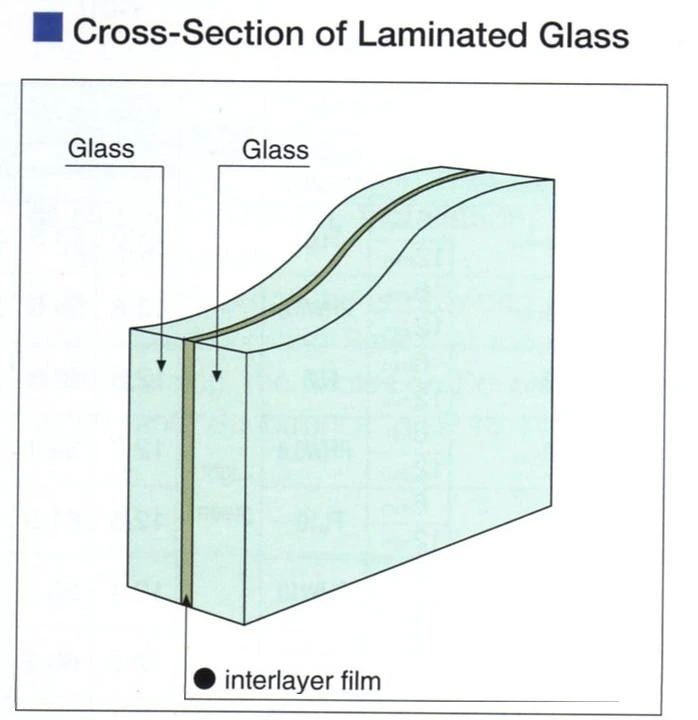
This process bonds two sheets of ordinary (annealed) or tempered glass outside a transparent polyvinyl butyral (PVB) layer using pressure and heat, resulting in safety glass. Think of a glass sandwich with a very tough plastic filling. Typically, the glass sheets are 2.5 mm thick each, and the PVB 0.38 mm, adding up to 5.38 mm. We call laminated car glass “5.38.”
As an extreme example, the BAC/SAF Concorde aircraft windshields had seven plies — four glass and three PVB — giving it a total thickness of 38 mm. The current Boeing 787 airliner has a windshield consisting of five layers. It uses slightly more advanced materials than the average Ford Fiesta. James Bond’s Aston Martin (in the film No Time To Die) portrayed bulletproof glass windows — these typically consist of laminated glass sheets with sandwiched layers of polycarbonate. It looked pretty effective.
The advantages and applications of laminated glass
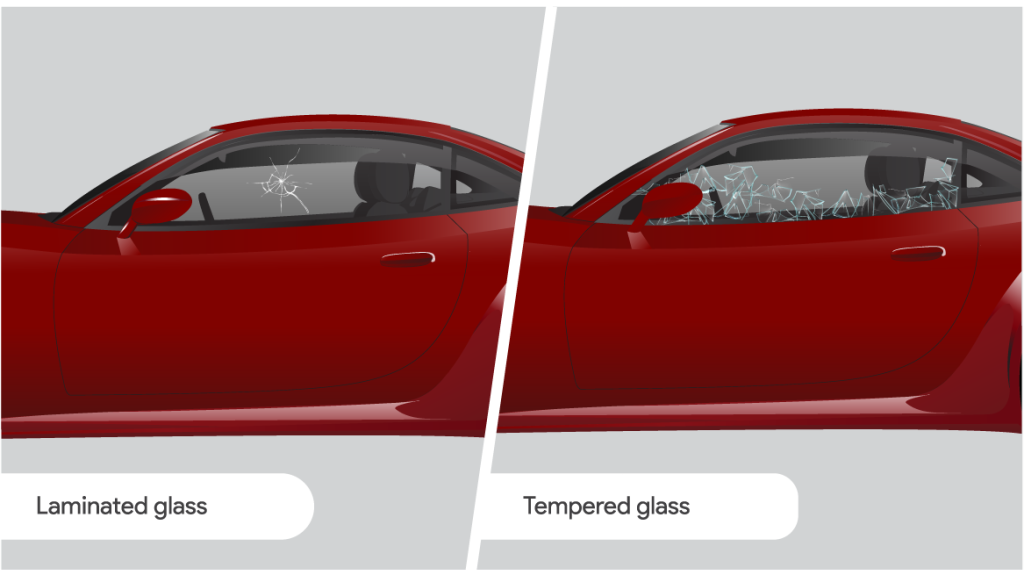
On impact, the resulting fragments adhere to the interlayer and cracks form (similar to a spider’s web). Due to the lack of loose shards of glass, fewer injuries occur.
Though laminated glass cracks more easily than tempered glass (discussed below), it will bend and stretch with the blow or impact due to the PVB layer. The interlayer distributes the impact force over a larger area, improving the impact resistance and lessening the chance of an object entering the cabin.
This type of glass features:
- High levels of rigidity
- Good security (in the event of accidents, airborne debris and vehicle break-ins — the glass tends to “stretch” and “bend”)
- Laminated side glass is less likely to shatter on impact and will thus prevent occupants from falling out of a window in an accident
- Low optical distortion (great view of the outside world and the road)
- Excellent acoustic insulation (decreased engine, road, traffic and wind noise — you will hear the sound system)
- Exceptional durability and is repairable (to a point)
- The interlayer is available in various tinted hues and thus protects passengers against harmful UV rays
For quality control, manufacturers test the type by exposing it to 90 degrees Celsius — for at least 90 continuous hours.
Due to its safety properties, laminated glass is mandatory for car windscreens and optional on other vehicle windows. It is expensive and heavy.
The history of tempered glass
The results of glass tempering have been around since circa 1660.
Prince Rupert of the Rhine showed King Charles II something called Prince Rupert’s Drops. These teardrop-shaped bits of glass were molten drops popped into a bucket of water to cool them rapidly.
A blow from a hammer on the bulbous end will not break the drop, but the slightest damage to the tail-end will disintegrate the drop immediately.
In 1874, François Barthélemy Alfred Royer de la Bastie of France developed tempered glass by dipping melted glass in warm oil — patented in England in 1874 and referred to as Bastie glass.
Friedrich Siemens developed compressed glass (or Siemens glass) by forcing hot glass into a cold mould. The result was a tougher, tempered product.
Austrian chemist Rudolph A. Seiden (born in 1900) held the first patent for the complete tempering process.
In 1929, the Saint-Gobain Laboratory developed the Securit tempering process with research undertaken at the request of the automotive industry.
The construction of tempered glass
Manufacturing of tempered (or toughened) glass consists of strengthening a sheet of glass by fast cooling it (from 600 to 300 degrees Celsius in a few seconds), resulting in a safety glass. Tempering compresses the outer surfaces and tensions the inner surface causing the glass to shatter into harmless chunks (not sharp shards). The process makes it four times more robust and also more durable and heat-resistant than regular annealed glass.
Advantages and applications of tempered glass
An impact shatters tempered glass into many small non-cutting fragments. One can rub these fragments harmlessly in the hands. This glass invention significantly reduces injuries in car accidents where sharp glass shards would have been fatal.
Compared with laminated glass, the tempered variety lacks durability, soundproofing, rigidity, optical quality and security. However, it is exceptionally safe in case of an accident.
In general, most vehicle windows are tempered (except for windscreens) and are available in tinted format.
Tempered glass is cheaper and weighs less than laminated glass — saving money on the initial capital outlay and lifetime fuel cost (due to the lighter car).
It is non-repairable, requiring a complete replacement.
What type of side glass does my vehicle have?
- Ask your car glass specialist
- Etched in the lower corner of the side window should be the manufacturer’s name, a code and the word “laminated” or “tempered”
- Roll down the window, and the top edge should indicate a layered construction (laminated) or no layering, i.e., a smooth single piece (tempered)
Post-accident escape from a car by way of a window
Due to the strength of a laminated windscreen, post-accident escape through the front window might not be an option. Furthermore, time could be critical. Planning one’s actions for such an event is a good idea.
- Try exiting through a door
- With a blocked door, try to roll the windows down
- Should the windows malfunction, you will need to break one. The closest tempered glass window (typically side or rear windows and sunroof) is the best choice
- Shielding your eyes, break the window with a glass break tool or any other suitable object
- Clear the remaining glass around the window frame
- Cautiously escape, staying clear of the frame due to possible remaining shards
- Above all, follow the instructions of emergency service first responders
Key takeaways
- Laminated glass = two sheets bonded with a PVB interlayer; mandatory for windscreens; cracks but holds together
- Tempered glass = single sheet rapidly cooled to compress the surface; used for side and rear windows; shatters into rounded chunks
- Laminated is repairable up to a point; tempered must always be replaced when damaged
- Standard UK windscreen is “5.38” (2.5 mm + 0.38 mm PVB + 2.5 mm)
- Knowing which is which matters for emergency escape — break a tempered window (side/rear), not a laminated one (windscreen)