
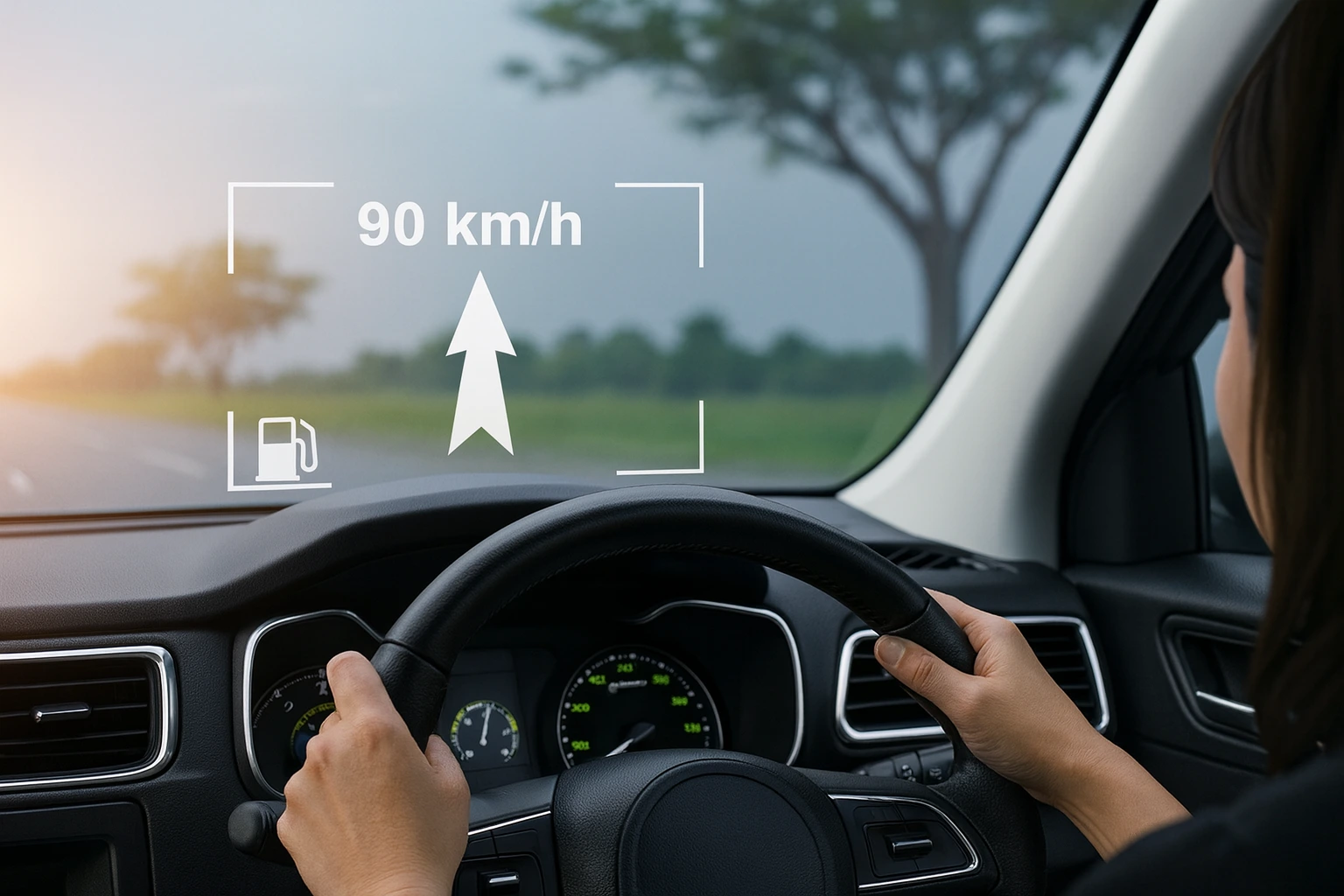
A heads-up display, or HUD, is a clear display that projects images onto your windscreen. This allows you to see important information without taking your eyes off the road.
A Heads-Up Display in a car represents a technological marvel that projects vital information onto a transparent display directly in the driver’s line of sight.
Initially developed for military aviation to enhance pilots’ situational awareness while keeping their attention focused forward, HUD technology has since expanded into various sectors, most notably the automotive industry.
This nifty gadget has improved the driving experience, making our lives behind the wheel easier and safer. One of the key benefits of having a HUD is that it reduces the time a driver takes their eyes off the road, increasing safety.
HUDs prevent distractions from infotainment screens or dials by providing information in the driver’s field of vision. They also improve concentration and reaction time, enhancing the overall driving experience.
From fighter jets to luxury cars like the Audi A7, HUD technology has come a long way — and windscreens with HUD technology are also more expensive.
How heads-up display works
The concept dates back to the mid-20th century, with its initial application in fighter aircraft during World War II.
These early versions aimed to provide pilots with critical data such as altitude and airspeed without diverting their gaze from their flight path.
A HUD system typically includes a projector unit, a combiner, and a means to display data. The projector casts images or information, which the combiner then reflects towards the viewer, creating the illusion that the display is floating ahead of them.
Types of heads-up displays
There are primarily two types of HUDs: combiner HUDs and windscreen HUDs.
Combiner HUDs use a small, transparent screen to display information, while windscreen HUDs project information directly onto the vehicle’s windscreen.
In a car, a HUD will display speed, navigation directions, and ADAS alerts directly onto the windscreen.
Eyes on the road: benefits and limitations
One major benefit of head-up displays is that they significantly reduce the time drivers take their eyes off the road and keep the driver’s attention focused on the road ahead.
The increased visual awareness can help prevent accidents caused by distracted driving and improve reaction time in critical situations.
In addition to enhancing safety, head-up displays provide customisable information for the driver. They can display blind spot warnings and traffic sign information, further enhancing awareness of the surrounding environment.
However, it’s important to note some limitations and considerations with head-up displays. The visibility of the projected image may be affected by bright sunlight or polarised sunglasses.
Some drivers may find the projected information distracting or overwhelming.
The display quality can vary depending on the projector and combiner technology used. We have first-hand experience with OEE quality needing to be better for newer car models.
In these cases, we limit ourselves to only using OEM quality for these replacements, as the information projected onto the HUD has been reported to be blurry. For us, quality and safety are everything.
Benefits of using heads-up display
- Enhanced safety: by displaying information in the driver’s line of sight, HUDs reduce the need to look away from the road, potentially decreasing the risk of accidents.
- Better focus on the road: HUDs ensure drivers can constantly focus on their surroundings, improving reaction times.
- Ease of use and convenience: HUDs offer a seamless way to access important information, such as navigation directions or speed, without interrupting the driving task.
The future of heads-up display
As technology advances, the potential for HUDs expands, incorporating augmented reality (AR) and integrating with other cutting-edge technologies to provide even more immersive and informative experiences.
Conclusion
Heads-up display technology is a testament to human ingenuity, offering a blend of safety, convenience, and futuristic interaction with our vehicles and devices.
As we move forward, the evolution of HUD promises to redefine our relationship with technology, making our journeys safer and our adventures more informed.
Key takeaways
- HUD projects speed, navigation, and ADAS alerts onto the windscreen in the driver’s line of sight
- Two main types: combiner HUDs (small transparent screen) and windscreen HUDs (projection onto the glass itself)
- HUD-equipped windscreens cost significantly more to replace because of the specialised glass spec
- We typically use OEM-standard HUD glass on these jobs — OEE quality on HUD has been reported to produce blurry projection
- HUD does not replace driver attention; visibility can drop in bright sun or with polarised sunglasses